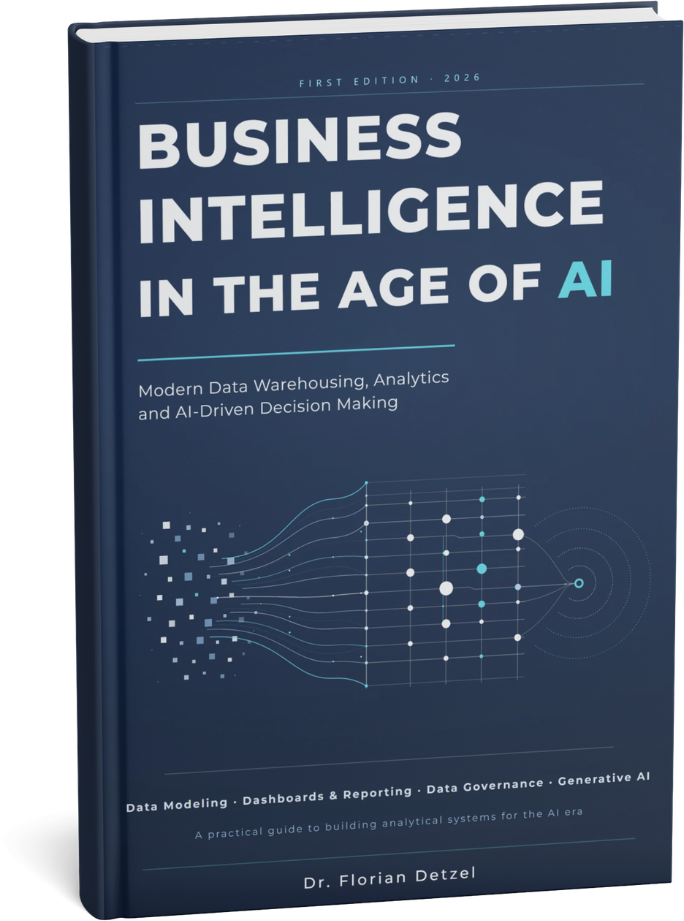
FIRST EDITION · 2026
Business Intelligence in the Age of AI
Modern data warehousing, analytics, and AI-driven decision making: a practical, end-to-end guide from foundations to deployed AI, by Dr. Florian Detzel.
AI didn’t retire Business Intelligence. It raised what BI has to deliver. A copilot will answer any question you ask it, including the wrong one, with the same fluent confidence either way. This book is about the judgment that tells the two apart.
Why this book, why now
Every analytics team now has natural language query, AI copilots, and dashboards that promise instant answers. Ask an ungoverned model the wrong question and it still answers: fluent, confident, and wrong. Closing the gap between a fast answer and a correct one is what this book is for.
This isn’t a tool tutorial, and it isn’t an AI hype book. It’s a map of the modern analytics stack, from the data warehouse to the copilot sitting on top of it, built around one running case study: a fictional rental company called Avelto Rentals. You follow a single business question as it travels from raw operational data to an AI-generated answer, and see exactly where trust can break down along the way.
“AI without governed data is just a fluent interface sitting on top of ambiguity.”
Dr. Florian Detzel
Who it’s for
Readers who want more than a list of tool names, and a reason for why a BI system is built the way it is.
What you’ll be able to do
Six capabilities the book builds, chapter by chapter, from the warehouse to the copilot.
Inside the book
13 chapters running from foundational concepts to agentic AI, each anchored in a single running case study, the Avelto Rentals scenario, with an AI Perspective section, worked examples, and a chapter quiz.
01 BI in the Age of AI
Core concepts and theory, the Avelto Rentals scenario, and how AI is evolving BI’s role and impact.
02 BI Fundamentals
The BI value chain, the canonical BI architecture, and the roles and responsibilities of a BI team.
03 Data Modeling & OLAP
OLTP vs. OLAP, dimensional modeling and granularity, and how AI reshapes the semantic layer.
04 Data Warehousing & ETL
The data warehouse, core architectural patterns, and the ETL vs. ELT integration pipeline.
05 Metadata Management
Metadata types, the semantic layer, lineage and the data catalog, and governed AI augmentation.
06 Dashboards, Reporting & Data Visualization
Reporting vs. dashboarding, design principles and perception, choosing the right visual, KPIs and storytelling.
07 Data Quality, Governance & Adoption
Data quality and security, adoption and culture, and rebuilding trust after it breaks.
08 Data Lakehouse & Modern Architectures
From warehouse to lake to lakehouse, data mesh and data fabric, unstructured data, vector search and RAG.
09 Self-Service BI & The Consumer Experience
Democratization, natural-language query, conversational BI, and AI copilots as the new front end.
10 Predictive & Prescriptive Analytics
Machine learning models in BI, forecasting and scoring, scenario analysis and recommendations.
11 Generative AI for BI Developers
LLM-assisted code generation for SQL, DAX and Python, RAG applications, and ethics and governance for generative AI.
12 Outlook: Process Mining & Beyond
Process mining, a closing synthesis, and reading event trails as decision intelligence.
13 The Future of BI in the Age of AI
Augmented BI, agentic AI, the skills tomorrow’s BI professional needs, and a future-ready operating model.

ABOUT THE AUTHOR
Dr. Florian Detzel
Dr. Florian Detzel has built his career on both sides of Business Intelligence: first as a university educator making complex data concepts click, then as a practitioner building data warehouses, models, and analytics platforms with tools like Power BI and MicroStrategy inside real organizations.
As founder of BI-academy.org, he now teaches the discipline he wishes existed when he started: one that treats AI as a powerful new front end for BI, not a replacement for the craft behind it.
“My goal is not only to explain Business Intelligence and AI, but to help readers develop the mindset needed to thrive in a data-driven world.”